Thursday, 2 December 2021

Citizen-scientist genetic genealogy enthusiast

Forty years ago I started studying genetics and have enjoyed a career using computers to analyse scientific information. Two years ago I began reviewing DNA test results in support of family history research.

So far, sixteen people have entrusted me with access to their personal DNA information. That has given me the privilege of helping them, and also many other people, to build family trees and connect with new relatives. My genealogy website profile says, "Citizen-scientist genetic genealogy enthusiast. Willing to help others who want to dig deeper or try to solve family mysteries."

From the range of scenarios I have handled, here are some questions you can ask when looking at each person in your list of DNA matches:

  • Do I already know this person and how they are related to me?
  • Does the amount of DNA that we share confirm, or contradict, our relationship?
  • If I don't know them, do I recognise someone else in their tree, such as a common ancestor?
  • Is there a supporting paper trail, such as birth, marriage and death records?
  • Does the website suggest a possible common ancestor based on its automated compilation of every searchable tree?
  • Is there a tree elsewhere, and a supporting paper trail, to confirm that hint?
  • If there is no hint about any common ancestor, possibly not even a tree linked to their DNA results, is there someone else who matches us both and that enables me to make a hypothesis?
  • Are there other shared matches also pointing to the same conclusion?
  • Does my research show there is a cluster of DNA matches who all have a common ancestor amongst themselves?
  • Starting from that common ancestor in their family, does some extra research suggest a link back to me?
  • Is my match, or cluster of shared matches, distant and possibly false?
  • Are there any surnames or locations in common between my tree and theirs, possibly from many, many generations ago?
  • For a strong DNA match, is there an unknown ancestor, a 'brick wall', in the tree?
  • Can we rule out all the known ancestors, by process of elimination?
  • Do we both have complete family trees but no-one in common?
  • Has all the evidence been checked, with no guesses or assumptions, and no possibility of a mix-up?
  • Could one of us have a tree that, although linked to the DNA, is not the biological family?
    • The tree is for the family into which they were adopted, rather than their birth family?
    • The DNA results are actually someone else's, not the person named?
    • Someone, somewhere in the tree, has an 'NPE' - Not Parent Expected?

I'm willing to help others and willing to share my experience. However, when writing posts here that concern recent generations I will change names to respect privacy.

Friday, 5 July 2019

Selway of Somerset - part 3

In the previous post (Selway of Somerset - part 2) we noted that Mary Selway married Thomas Porch in Wisconsin, USA, although both had been born in Somerset, England.  Mary Elizabeth Maidment Selway was baptised on 16-Jan-1830 in the church of St Mary Magdalene, Chewton Mendip, daughter of James and Eliza (formerly Maidment).  Her husband Thomas Porch had been baptised 12 years earlier on 15-Feb-1818, less than 10 miles away in St Peter, North Wootton, son of John and Ann.

Did these two families know each other in Somerset before they emigrated and were linked through marriage in Wisconsin?

When Mary was baptised as a baby in 1830 she was given the name Mary after her father's mother.  Later when she married she took the name Porch and, whether or not she knew it at the time, this was her grandmother's maiden name.  Grandmother Miss Mary Porch became Mrs Selway and her granddaughter swapped names the other way, going from Miss Mary Selway to Mrs Porch.

Could Thomas Porch, baptised in North Wootton in 1818 be connected to his bride's grandmother Mary Porch, whose marriage placed her in the same parish in Somerset?

The St Peter North Wootton parish register entry for Mary's grandparents in 1781 lists:
  • Bride: Mary Porch
  • Groom: James Selway of Green Ore, Witham Friary
  • Witnesses: Sarah Selway and Mary Read [Reed]
In the same parish 25 years later, the entry for the marriage of Thomas' parents in 1806 lists:
  • Groom: John Porch
  • Bride: Ann Clark
  • Witnesses: Henry Clark Senior and Junior
With no mention of Porch relatives for either of these marriages there is little evidence to make a link other than the basic facts of same surname and same parish.

Thursday, 27 June 2019

Selway of Somerset - part 2

In the previous post (Selway of Somerset - part 1) I pointed to a Find a Grave memorial which says about Mary Selway, daughter of James and Eliza (formerly Maidment): "James and daughter, Mary, went back to England to settle an estate when James became sick and died in Somersetshire. Mary stayed in England."  The source is quoted as "Beaverhead Co. History Book, Vol. II".

Elsewhere (Tribune-Examiner, September 03, 1980, Page 19), the same details and more are found.  I read in that Centennial Edition of the newspaper about the children of James and Eliza in Beaverhead County, Montana, "The four boys took up homesteads in the county. [...] The girls married local ranchers except for daughter Mary who remained in England after her father's death and married Tom Porch in Somersetshire. When her two sons, Henry and Tom Porch, were grown they came to Dillon to ranch".

A family memoir available on the internet (by Florence Carter Backus, 1952) says much the same, "James Sr. and daughter Mary (oldest child) returned to England to visit. James died there. Mary stayed there and raised a family."

All these sources, and some others, suggest that Mary Selway returned to England, remained in England, married in England and had children in England.

However, although parish records show that Thomas Porch was baptised in North Wootton, Somerset, England, civil records in the USA show a marriage between Mary Selway and Thomas Porch in Wisconsin, in 1849, a few years after the Selway family emigrated.  Then in the same place four children were born to Mary and Thomas Porch.

All things considered, the return trip to England seems not to have been James Selway and an unmarried daughter Mary Selway.  It was James Selway, his married daughter Mary Porch plus Mary's husband Thomas and their children.  The long journey included three generations of a family across an age range of under 5 years old up to about 75 years old.

Wednesday, 19 June 2019

Selway of Somerset - part 1

Puzzle pieces and solutions come in all shapes and sizes.  James Selway, my great-great-great-great-uncle, was baptised, married and buried in the same church - St Mary Magdalene, Chewton Mendip, Somerset, England.  All of his brothers and sisters were baptised in the same church across a period of more than 20 years.

Their father before them, also James Selway, was baptised (1755) and buried (1816) in the same village, although he had married Mary Porch (1781) in her parish church of St Peter North Wootton nearly 10 miles away.  These were my great-great-great-great-grandparents.

James Selway, son of James and Mary, was married in 1829 to Eliza Maidment and they were recorded in the 1841 census with seven children living at Double House, East End (note: map drawn in 1884).  An eighth child was born the following year.  Then the whole of this family disappeared from Chewton Mendip until 26 years later when James was buried there in 1868, noted as age 78.  I will not list the unsuccessful approaches which I tried to find them in the intervening years ...

Then I came across the Find A Grave memorial entry for Eliza.  The record matches her first name, maiden name and married surname, as well as mentioning Chewton Mendip.  It told me that she died only two years after her husband James but more than 4,500 miles away!

Wonderfully, that database includes a biography for Eliza which says, "James and daughter, Mary, went back to England to settle an estate when James became sick and died in Somersetshire."  In fact many people have recorded information about this pioneer family, which included another child who was born in the USA.  The sources are rather varied, such as:
So it seems that James and Eliza emigrated to the USA in 1846 and about 18 years later Eliza stayed there when her husband returned to their starting point, never to see each other again.  James was indeed buried in the place where he was born and baptised, after a round trip of nearly 10,000 miles.

Tuesday, 11 June 2019

The Penny Husbands

In the previous post we distinguished between two men called Edward Turton and their respective spouses (The Turton Wives).  From FreeBMD we can know that since civil registration began in England and Wales there have been over 70 marriage registrations with the name Edward Turton.

By contrast FreeBMD shows only seven marriage registrations for the name Jabez Penny.  Sounds like an easier starting point.  However, there are three birth registrations for Jabez Penny within a two year period of time (with just one earlier birth and another entry a generation later).  Selecting the relevant details for the person of interest was achieved by piecing together information about the life of each of five people with the same name.

Jabez John Penny, son of Robert and Ann, was born in Kent in 1841.  He became a school master like his father before him.  Jabez married Mary Hanson Jones, daughter of a school master and a teacher herself, in 1866 in Portsea, Hampshire.  His widow died in 1917, age 77.  It is possible that his death was the one registered in the same district 18 years earlier as John Penny.

In Bristol, James Penny married Celia Legg in 1850, they had a son Jabez Penny in 1851 who died aged 1 in 1852.  Then they gave the same name to another son who was born in 1853 and baptised on Christmas Day.  Their second Jabez married firstly in 1875 to Margaret Wood who unfortunately died within a year.  Then he married Caroline Baker in 1881, had various roles related to making and selling paper, died in Barnstaple, Devon in 1919, age 66, and is buried in the town cemetery with his wife Caroline's name on the grave monument.

Between those two births, a Jabez Penny was born in 1852 in Wiltshire to Henry (Harry) Penny and Harriett (Harriet) formerly Burton, who had married in 1838.  This Jabez, a labourer, was married first in 1874 to Dinah Ann Kiddle, age 18, but sadly she died before their 10th wedding anniversary.  He went on to marry Rebecca White, age 26, in 1886, who lived until 1913, a marriage of 27 years, during which time he progressed to being a road foreman working for the district council.  Then in 1914, in his early 60s, Jabez married the much younger Kate Elizabeth/Elizabeth Kate Elcock who was age 25 and their marriage continued for 24 years until his death age 85 in 1938.

In Essex, Thomas David Penny, a millwright who had been born in Brighton, Sussex, and his wife Agnes had their Jabez Penny in 1888.  He married Mabel Simpson in 1920 and died in 1962 age 74.

Please do not hesitate to contact me with any corrections or further insights.  However, beware if you are checking against compiled information available on the internet because several sources have muddled up these Penny people.

Monday, 3 June 2019

The Turton Wives

In the 1881 census, in the High Street of Brading, Isle of Wight, Hampshire, we find Edward Turton in a household with two entries for Wife - Hannah and Elizabeth.  Shocking!

Reading the names on the page carefully, in sequence, with their respective ages, we see:
  • Edward Turton, Head, age 71
  • Hannah Turton, Wife, age 61
  • Edward Turton, Son, age 31
  • Elizabeth M Turton Wife, age 32
So, another example of relationships recorded on the census not actually being relationship to the Head of the household.  Elizabeth, listed as the second Wife in the household, we may assume was connected to Edward junior and was really the daughter-in-law of Edward senior.

Searching FreeBMD shows the following marriage couples in the Isle of Wight:
  • Edward Turton and Hannah Westcott married in 1846
  • Edward Turton and Elizabeth Marshall Fowler married in 1880
So Edward junior was recently married and had brought his new wife to live in his parents' home.

The 1881 census records occupations for the men and the women too:
  • Edward senior - Hairdresser Employing 2 Men, with an Apprentice Hairdresser in the household, age 16.
  • Edward junior - Hairdresser
  • Elizabeth - Ladies Hairdresser
  • Hannah - Lodging House Keeper, with a Domestic Servant in the household, age 18.
Hannah was a long way from her early life as the daughter of a Labourer in Devon, whilst Elizabeth, also known as Lizzie, was the daughter of a Hairdresser from Yorkshire.

Sunday, 26 May 2019

The Moore Granddaughter

Eliza E Moore, age 7, born Christchurch Hampshire, was a Granddaughter in the household of William and Elizabeth Moore in the 1871 census (mentioned previously in 21 siblings - part 3).  In the next census Eliza was still with them, age 17, occupation Dressmaker.  Life moved on for her and in the 1891 census she was a Ladys Maid, progressing to Housekeeper by 1901 and then in the 1911 census her occupation was Proprietress Apartment House, with a Parlour Maid and Kitchen Maid living there too.

There was a death registration for Eliza E Moore age 76 in 1939 so it seems she remained unmarried.  That deprives us of the opportunity to find her father's name on a marriage certificate.  Also, there is no sign of a birth registration for Eliza Moore in the Christchurch district, which would have provided the name of her mother and father.  So who were her parents and which one of them connected Eliza to the grandparents in whose house she lived during her childhood?

Let's examine the census records more closely for any clues about family connections:
  • 1891:  Ladys Maid in the household of Lavinia A Dutton age 76, Head of the household, Widow, occupation: Living On Own Means, and her Daughter Louisa E L Dutton age 40, Single, occupation: Chicken Fancier.  In total there were four Servants: Housekeeper, Ladys Maid (Eliza), House Maid and Footman.
  • 1901 census  Housekeeper-Domestic, with two young women as General Servant-Domestic, in the household of Frederick Lovell age 57, Lodging House Keeper.
  • 1911 census  Proprietress Apartment House and in her household was Frederick Lovell age 68, Widower, Stepfather.
Now let us not get distracted by the concept of being a Ladys Maid to a Chicken Fancier!  Note that in 1901 Eliza is a Servant Housekeeper in the Lodging House of Frederick Lovell then 10 years later the two of them are still together but Eliza is the Head of the household, Proprietress, and Frederick is recorded as her Stepfather, which would make him the husband of Eliza's mother.  What luck - a new clue!

There was a marriage registration for Frederick Lovell and Phoebe Moore late in 1879 and a little over a year later Frederick Lovell age 37, Lodging House Keeper, was with his Wife Phoebe Lovell age 39 in the 1881 census.  Eliza was 16 years old at the time of the marriage between her mother and stepfather.

To summarise the overall story once the various information is joined together, William Moore married Elizabeth Hoskins who brought with her a daughter only a few months old called Phoebe Hoskins and she grew up in his home as Phoebe Moore.  Then history repeated itself - at about the same age as her mother had been, Phoebe had her own daughter, whose birth was registered and baptism recorded as Eliza Elizabeth Hoskins (1863, Christchurch).  Like her mother before her, Eliza grew up in William's home and used the surname Moore throughout her life.

Saturday, 18 May 2019

The Shorter Sister

In the 1901 census James Beeching was Head of the household in Brenzett, Kent, a village on the Romney Marsh.  The page lists Wife, Eliza Beeching, then three Sons, a Daughter and another Son who was not yet 1 year old.  The next line on the page is Annie Maria Stickells, Relationship Sister, Occupation Visitor, age 28, followed by Elizabeth Harriett Stickells, Daughter age 2.

Based on the position in the list, and the surname, I think that Elizabeth was the child of Annie on the previous line, and not Daughter to the Head of the household but actually his niece.  We know about the difficulties of connecting a niece to her uncle and aunt (see The Long Niece).  However, in this case we seem to have the child's mother present in the household, Sister to the Head, so surely it is a straightforward situation!

The census says Annie Maria Stickells was the Sister of James Beeching.  As the mother of a 2 year old, and with a different surname to her brother, we would expect to find a marriage between Annie Maria Beeching (or just Annie, or even Anne or Ann, perhaps) and a bridegroom with the surname Stickells (or some variant spelling, perhaps).  However, I have not found any such marriage registration.

Turing to the GRO Online Index, we can look for the birth registration of young Elizabeth Harriett Stickells and check her mother's maiden name there.  Indeed, there is a single candidate record and the good news is that it has the expected name, year and county.  However, the other news is that the mother's maiden name was recorded as Shorter, which is nothing like Beeching.

How did James Beeching come to describe Annie Maria Stickells, née Shorter, as his Sister on the census?  Was she actually his half-sister with a different father and surname?  In the previous census, in 1891, James was with his Wife, Eliza, and three Sons.  Ten years earlier, James, age 18, was with 2 older Brothers, William Beeching and Richard Beeching, then the census before that James is one of 5 children between the ages of 2 and 12 in the household of John and Sarah, all with the surname Beeching.  All rather straightforward and not providing any clues about the Shorter connection.

Then revelation!  Between the census with the Brothers and census with the Wife and children there was a marriage - James Beeching married Eliza Shorter in 1883.  So, Annie Stickells, née Shorter, is the sister of his wife rather than himself.  What a lot of confusion because the ink said "Sister" but missed out "in-law".

Friday, 10 May 2019

The Long Niece

In the 1881 census Susan M Shergold is age 18, unmarried, Niece in the household of Henry Long and Elizabeth Long.  Starting with the easiest options, we can consider the possible sibling relationships that would connect Susan to her Uncle Henry and Aunt Elizabeth:


Susan's father - Mr Shergold? Susan's mother - Mrs or Miss?
Susan's Uncle Henry Long Were Susan's father and Uncle Henry brothers? Were Susan's mother and Uncle Henry siblings with her maiden name Long?
Susan's Aunt Elizabeth Long Were Susan's father and Aunt Elizabeth siblings, with her maiden name Shergold? Were Susan's mother and Aunt Elizabeth sisters with the same maiden name?

In the attempt to draw their family tree, we can start by assuming that Susan has the surname with which she was born and see if she is with her parents in the previous census.  Indeed, a 7 year old with the same name and same place of birth is found in the 1871 census as Daughter to Emanuel Shergold, living in Shrewton, Wiltshire, with his wife Jane Shergold and three other children, too.
 
The wonderful FreeBMD website gives the following information from marriage registrations, after some consideration of variant first names: 
  • (Susan's uncle) Harry Long and Elizabeth Rowe (oh - not Shergold) married in 1873.
  • (Susan's father) Emmanuel Shergold and Jane Goddard (hmm - not Long, or Rowe) married in 1869 (less than 2 years before the census with Daughter Susan age 7).
The useful GRO Online index shows that the birth of Susan Mary Shergold in 1864 was registered with the mother's maiden name of Giddings.  Back in FreeBMD we can find that Emmanuel Shergold and Dinah Giddings married in 1855 and Dinah Shergold died in 1866, when her daughter Susan was 2 years old.  So we now know that in the 1871 census Susan is with her stepmother Jane but we are no closer to the uncle and aunt of the 1881 census, either through Susan's mother or stepmother.

Back to Susan's 1881 census household: consider that when Elizabeth married Harry Long, she brought him a Stepson William J Rowe.  If Elizabeth was married when William was born, and Rowe was her husband's surname, then we need to look further for her maiden name.  There was no marriage record for Rowe but with some more persistence:
  • George Roe and Elizabeth Shergold (ah ha - Shergold) married in 1855.
So it seems that in 1881 Susan was living with her father's sister, Aunt Elizabeth, lately Long, formerly Rowe or Roe and elsewhere Row, née Shergold.  Congratulations if you got the the end of this niece piece with me!

Thursday, 2 May 2019

The trouble with nieces and nephews

Usually, a census household of Head, Wife and one or more Sons and Daughters is easy to understand.  I say, "usually" because there may be a child of only one of these adults but not labelled as step-child, even if that is their true relationship to the head of the household.

Often there will be someone extra in the household.  That could be an unrelated person such as a Servant, Boarder, Lodger or Visitor, although sometimes such people do turn out to be connected to the family in some way.  Of more obvious interest is a bonus person who is clearly related, such as a Grandmother, Grandfather, Grandson or Granddaughter.

Occasionally I have seen a Cousin included in a household - if you have not already looked at "The Cousin Explainer" (Cheer's Cousin!) I recommend it to you now.  More frequently I have come across examples of a Nephew or Niece to the Head of the household.  The choice is to ignore them, make a note for reference, or go ahead and try to place them on the family tree in their own right.

To add a niece or nephew to the family tree it is necessary to identify at least two relationships - whether the line is through the Head or Wife, and whether through a brother (father to the child) or sister (mother to the child).  In my experience, I have found it best to consider the easiest options first but remain open to the possibility that there may have been remarriages, changes of family name, variants of first name, errors, missing records or unmarried mothers.

In the 1881 census, the household of Henry Long and his wife Elizabeth Long includes three children: George Long - Son, William J Rowe - Stepson and Susan M Shergold - Niece.  Now, remembering that the relationships recorded on the census should have been relative to the Head of the household, my first thoughts were:
  • George is the son of Henry and Elizabeth.
  • William is the son of Elizabeth by a previous husband.
  • Susan could be either Henry's brother's daughter, Henry's sister's daughter, Elizabeth's brother's daughter or Elizabeth's sister's daughter.
Phew!

Wednesday, 24 April 2019

Moore of Motcombe - part 4

Brothers William and John Moore had an Uncle James Bartley (see Moore of Motcombe - part 3).  Exactly how was this uncle related?
  • Father's brother?  No - their father was William Moore and his brother would share that surname.
  • Mother's brother?  No - their mother was Anna/Hannah Parsons and her brother would share that surname.
  • Father's sister or mother's sister was Aunt Bartley?  Most likely.  (Less likely would be that someone had an unexpected surname, different from the other members of their family.)
So what was the birth name of Aunt Bartley, wife of Uncle James Bartley?  The events we are learning about took place before civil registration so we are relying on church parish registers.  I am very thankful that the registers for baptisms, marriages and burials have been transcribed and are freely available on the internet (Dorset OPC (Online Parish Clerk) Motcombe).  Another advantage is that the extended family stayed in the same parish for many years.

From the Parish of Motcombe register transcriptions (Marriages 1672 - 1836 and Baptisms 1753 - 1812) we can see that:
  • James Bartlett married Harriet Parsons (Nov 1806).
  • Harriet Parsons (baptised Dec 1780) was the daughter of Joseph and Mary Parsons.
  • Anna Parsons (baptised May 1775) was also the daughter of Joseph Parsons (register only shows father's name at that time).
Also,
  • James and Harriet/Hariot had a son Walter Bartley (baptised Nov 1807) and a son Stephen Bartlett (baptised May 1809).
Selected family members related to John Moore and his Uncle James Bartley

So the relationship between nephews and Uncle can be established from the parish registers - with the acceptance that Anna and Hannah are the same person, Harriet, Harriot and Hariot are different spellings for the same name, as well as Bartley and Bartlett being variants for the same family name.

Tuesday, 16 April 2019

Moore of Motcombe - part 3

Having searched the internet for three keywords and found a prize clue (see Moore of Motcombe - part 2), I tried the same approach again, reviewing internet search results for a new combination of three words - Moore Motcombe Methodist.  My emotional high went up another level as I read, "John was born on 16 November 1807 at Motcombe to parents William and Anna. He was converted in November 1826 whilst attending a service at his uncle James Bartley’s farmhouse." (Moore, John (1807-1875)).

My great-great-grandfather William Moore had been baptised in 1805 in Motcombe to William and Anna, making him the older brother of this John Moore, Methodist convert.

A little more digging in the fertile swathes of the internet led me to a detailed biographical article about Rev John Moore.  Apparently he recorded the conversion event and stated it was "November 5, 1826, at half-past ten o'clock at night, while on my knees in the kitchen of my uncle James Bartley's farm-house".  (From Connexional Biography written by H.G. Button, Primitive Methodist Magazine 1876, page 297-299.)

Furthermore John Moore said, "My aunt Bartley was praying when I believed; but there were my brother, uncle Bartley, Walter, and Stephen on their knees at the same time. My brother and seven more had found the Lord at the meeting at Enmore Green the same night, where we had all been."

To my knowledge, John had one sister and one brother.  Consequently, I concluded that my great-great-grandfather William Moore found the Lord at a Methodist meeting in the hamlet of Enmore Green, Motcombe, during the evening of Sunday 5th November 1826 at about 20 years of age.

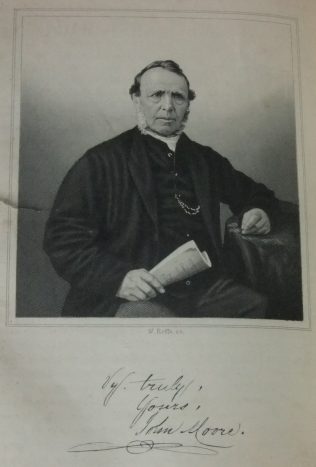
I was truly delighted and amazed to have found such personal and specific details about a relative from nearly 200 years ago.  However, once I had absorbed the article's biographical details about John Moore, and stared a picture of him in later life (see below), I immediately started wondering about the identity of Uncle James Bartley, Aunt Bartley, Walter and Stephen.  This hobby is a never-ending chain of mysteries - once new facts have been recorded then new loose ends beguile.

Image presented on "My Primitive Methodists" website page Moore, John (1807-1875)

Monday, 8 April 2019

Moore of Motcombe - part 2

Previously, we saw that William Moore, blacksmith, and his wife Hester (Ester) had a son baptised in an Anglican church in Motcombe, Dorset in April 1830.  Then four years later they had two children baptised in a Methodist Chapel in Salisbury, Wiltshire.

The record of William and Hester's marriage had not mentioned occupation or parents.  However, after her death when he remarried in 1840 that registration recorded William Moore as a blacksmith of Motcombe and his father was also William Moore, blacksmith.

A few years later there was a marriage registration for Meshach Moore, a blacksmith of Motcombe with his father named as Meshach Moore, blacksmith.  I assumed that with the same surname, sharing the same specialised occupation, in a village of about 1,500 inhabitants (1841 data quoted in Hunt's Trade Directory of 1851), these men were likely to be related to one another.

There was some support for this idea - Meshach was a witness at William's marriage.  However, looking at the parish register as whole, it is striking that the name Meshach Moore appears as a witness on nearly 25% of 700 or so marriages there over a 34 year period of time (data from "Parish of Motcombe Marriages 1837 - 1875 transcribed from parish registers by Jan Genge Kennedy 2003").  According to the 1851 local trade directory Meshach Moore was "blacksmith and parish clerk".

Searching the internet for the three keywords - Moore Motcombe Blacksmith  - I was delighted to find a page called "History of Motcombe Forge".  It says, "From 1822 three successive generations of the same family at Motcombe Forge were parish clerks and blacksmiths, all having the same name of Meshach Moore."  So the 150 or so marriage registrations from 1837 onwards were probably not all witnessed by the same Meshach Moore.

Reading on, the History of Motcombe Forge page also declares, "work was obviously plentiful as there were two other forges in the village, although one of the new blacksmiths was a dissenter (a Primitive Methodist) and he did not get any work from the Lord of the Manor or the Church!"  So could this be a description of my great-great-grandfather - a religious non-conformist who lost customers in his home village?  William Moore's link to Salisbury may have been to find work as well as to connect with fellow Methodists there.

Sunday, 31 March 2019

Moore of Motcombe - part 1

On 16 September 1827 my great-great-grandfather William Moore, Bachelor of Motcombe, Dorset, England, married Hester Dowland, Spinster, in her parish church of Holy Trinity Shaftesbury.  Banns had been published in both of their churches on three Sundays in August.  For the wedding day itself, the parish marriage register show signatures for the groom, bride and two witnesses, Mary Moore and John Bennett.

Having married in her parish, the couple then lived in his parish, as was typical.  Two-and-a-half years later on 18 April 1830 William and Hester had their son William baptised in Motcombe, with the father's occupation recorded as blacksmith.  This seems to be the only time that the couple appear in that Church of England baptism register.  A researcher starting from here could easily assume that William Moore had only one child.

They could have died.  They could have moved.  With such a common name, the hope of finding what happened to them next seemed small.  However, in 1834 there is a record showing that Charles Dowland Moore son of William Moore and his wife Ester, daughter of John and Ester Dowland, was baptised in St Edmund's Church Street Methodist Chapel, Salisbury, Wiltshire.  The couple had chosen this Wesleyan church for the baptism, and helpfully this church recorded the mother's parents' names too.

Was a relocation more than 20 miles to Salisbury plausible?  To my amazement I read online recently, "In 1827 Salisbury was regularly visited by preachers from the Primitive Methodists in Motcombe" (Salisbury Methodist Church History).  If the names on the baptism record were not enough, this link between the locations was further evidence that I was looking at the right family.

In fact, it was double celebration in the church that day.  Charles Dowland Moore and Ester Nott Dowland Moore were both baptised on 26 March 1834.  Charles was the younger child and his birth is recorded on the baptism record as 25 January 1834.  Ester's entry gives her date of birth as 27 October 1832, showing that they were siblings rather than twins.

The baptism records for Charles and Ester (elsewhere called Hester) both include Dowland for a middle name, which was their mother's maiden name.  In addition, the record for Ester also includes the name Nott.  Elsewhere I have seen their maternal grandmother's maiden name as Knott so I could say, "not Nott but Knott".

Saturday, 23 March 2019

21 siblings - part 4

Although William Moore died in 1890, his widow Elizabeth formerly Hoskins, appeared in another three census reports, surviving to 1914 when she died age 92.

The 1911 census aimed to gather new information from each married woman: how many years they had been married, how many children had been born alive, the number still living and a count of the number who had already died.  The intention was that this data was only collected for the woman's current marriage, without reference to any previous marriage, without counting step-children, and without any data required from widows or husbands

However, Elizabeth Moore, Widow, filled in these columns on her census form.  She wrote that her marriage had produced 13 children, of which 4 were still living and 9 had died.  This called for a review to see if I could ascribe 13 children to Elizabeth and work out which 4 were still alive in 1911, with confirmation about the deaths of the other 9 of her children before 1911, if possible.

To date, I have only been able to identify 11 birth registrations for William Moore and Elizabeth.  They married in 1842, a unnamed baby girl was born and died a year later.  After that births were registered every two to two-and-a-half years until 1864, when Elizabeth was in her mid 40s.  There is no apparent gap in the sequence to suggest there is a child missing on the timeline.  However, I am still open to that possibility.

Then there was the little matter of confirming who were the parents of all the others in the set of 21 children that included my great-grandmother Moore.  Phoebe Moore who is age 9 on the 1851 census seems likely to be the Phoebe Hoskins whose birth was registered in 1841 with no father named.

William's oldest children were born before civil registration began, following his marriage to Hester Dowland.  The next blog post will be all about them.  Meanwhile, the middle of William's three wives, Amelia Lear, died only one-and-a-half years after their marriage.  She did feature on the 1841 census as part of the family but apparently did not contribute any children to the flock.  As with the rest of the details about this large family, I await correction or new information from descendants or other enthusiasts.

Friday, 15 March 2019

21 siblings - part 3

Recently I reviewed the census records for the Moore family to remind myself about the various members and perhaps follow-up what happened to the younger generation when they themselves had their own families.

The records for 1841 did not include family relationships - just a list of names, ages (with each adult's rounded down to the nearest multiple of 5) and "Profession, Trade, Employment" with an indication of whether each person was born in, or out, of their present county.  However, based on the ages, it seemed reasonable to conclude that the household consisted of father, mother and four children.

For 1851 onward the census records showed that there were various combinations of sons and daughters in the household of William Moore.  My attention was caught by some unexpected lines on the 1871 and 1881 census pages:
  • In 1871 there was a granddaughter Eliza age 7, still there in 1881 age 17. 
    I tried to make sense of the relationships and ages: my great-grandmother age 16 was a year younger than Eliza but was actually her aunt!
  • In 1871 there was also a boarder (lodger) Charles Parsons, age 22, unmarried.  By 1881 he was head of the next household down the page, age 32 and married with a wife called Mary, also age 32.  In fact in 1881 the household of Charles Parsons included a step-son called Ernest Moore age 12.
    To summarise my surprising conclusions: the 1871 household of William Moore contained his unmarried daughter Mary age 22, a grandson age 2 and boarder Charles.  By the 1881 census Charles and Mary had married and their family comprised three children including what turned out to be Mary's son.
Eventually, I noticed the address column on the left of the 1881 census page.  The top of the page showed that William was (still) living in Commercial Road, Bournemouth (see NLS Historic Maps).  The line for his household said "No 94" ("No" being a short form of "Number"), an improvement on the previous census which had no street numbers.  Then, to my further surprise, I saw that his daughter and son-in-law in the next household were actually living at "No 94a".  This was an extended family where generations overlapped in time and space!

Therefore, if we count Eliza who was part of William's household, and his other grandchildren who were also living right there, then the total number altogether reaches 21.  No exaggeration, no poor memories, no counting miscarriages - just a close family where all those under William's roof over the years may have considered themselves as brothers and sisters.

Thursday, 7 March 2019

21 siblings - part 2

Using census records I had found the names of 11 out of an expected 21 children in the family of my great-grandmother Moore (see 21 siblings - part 1).  The next stage came years later when I discovered that, without purchasing each certificate, I could find the mother's maiden name for births registered in England from 1837 onwards using the GRO Online Index.

Once I was certain that I had the details of William Moore's marriage to Elizabeth Hoskins, which was in 1842, then I looked for births registered with the surname Moore and the mother's maiden name Hoskins.  My great-grandmother, Frances Kate Moore born in 1864, seemed to be their last child.  Before her was a birth registration for Emily Jane Moore in 1862, a daughter who had not appeared on any census with the rest of the family.

A search of the death registration index found an entry for Emily Jane, in the same registration district, 2 years after the birth and recorded as age 2.  There were other losses as well.  A birth registration for Walter in 1857 was matched by a death registration in the same quarter of the year.  Harriet died age 1 and a couple of years earlier Alice had died without reaching her first birthday.

Using this approach of comparing birth registrations with the father's and mother's surnames against death registrations I found the earliest case was the most poignant.  In 1843 a baby girl was born alive (only live births are included in the usual registration index) but died without having been given a name.

With a heavy heart, I added these 5 children to the family tree.  Combining those who appeared in the census records, plus those who were born and died in the intervening years, there was now a set of 16 siblings.  A better research result but still short of the expected 21 in the family.

Not for the first time, I wondered whether the story passed down the generations was a slight exaggeration or the result of the family just not remembering accurately how many babies were born altogether.  Another possibility was that as well as experiencing the death of babies and young children, perhaps there had been stillbirths that were included in the total.  I put the topic aside, not expecting to ever be able to piece together the whole family.

Wednesday, 27 February 2019

21 siblings - part 1

Early on in my family history conversations, a relative told me that my great-grandmother came from a very large number of siblings - about 21 (see Miss, Mrs, Mrs).  No-one could tell me who they all were but over the decades, as I became more experienced and as extra sources of information became accessible, I added more of her brothers and sisters to my list.

In the 1881 census my great-grandmother age 16 was at home with an older sister age 21 and their parents William Moore age 75 and Elizabeth age 60.  10 years earlier, in the previous census, William age 65 and Elizabeth age 49 also had 3 older children at home, making a total of 4 daughters and 1 son.  Back another decade and there are 2 further sons at home, age 14 and 16 at that time.  So that gets us to 7 children - a long way from the rumoured 21 siblings.

When I found the 1851 census record, the older children whom I had seen before were present and between the ages of 2 and 9 years with their parents William age 46 and Elizabeth age 29.  With them was a son called Charles age 17.  Great - I had found an extra person to count towards my target of 21 siblings.

However, Charles was only 12 years younger than his mother, presumably his step-mother.  Now the 15 year age gap between husband and wife made more sense.  With the running total of 8 children in the family, I knew it was worth looking for an earlier wife and children for William.

The 1841 census showed Charles age 7 and a younger brother age 6 as well as an older sister and older brother.  The addition of these 3 to the family tree brought the total up to 11 siblings from William and his wives.

At this point, I had found half of the family and been through all of the census years from William's lifetime.

Tuesday, 19 February 2019

15 Market Street, Redditch

As part of a visit to the Forge Mill Needle Museum (see Pins and needles), we strolled into the shop which "has guide books and a selection of local history books, cards and souvenirs for you to purchase as a reminder of your visit to the museums."  We were not interested in buying any of the extensive range of needles or a fridge magnet or even a tea towel.

However, as we browsed along the shelves we found a booklet of "Redditch on old picture postcards" by Chris Jackson (1994) and were somewhat shocked by one of the images.  There, in black-and-white, printed large across a double page (pages 12-13), was an image labelled "The Market Place, Redditch, No 949." and "H W Huckfield's Series" ...

In the foreground is a cluster of young children standing in the roadway and staring at the camera.  Behind them is an indifferent horse in harness between the shafts of some out-of-view cart or waggon which we can only see as a shadow on the ground.  In the background, above the doorway of a shop is a large, bold sign declaring:
15 McQUAY 15

Underneath the picture, the accompanying caption text (page 12) says, "Market Place when it had a market. For many year the stalls backed onto the church railings. Hepworth's Corner at the top of Unicorn Hill is in the centre of this postcard in the 'Huckfield' series (no.949) and McQuay's milliners is on the left."

Temporarily distracted from the tough McQuay pin pointers, I set to work investigating the distinctive McQuay milliners.  It seems that John McQuay and his wife Mary Ann, formerly Hollis, whom I have mentioned in previous posts here, had a daughter-in-law who was Mrs McQuay, Milliner in the 1888 Kelly's directory and the 1891 census, then Milliner and Dress Maker in the 1901 census.

In 1964 Redditch was designated a New Town which led to the demolition and redevelopment of many historic streets and buildings.  Many addresses no longer exist, now under the Redditch Ringway or the Kingfisher Shopping Centre.  However, 15 Market Place is still a valid address and if you go there you will find the Redditch Library (see Find the library on a map).  In a sweet twist, people can now access resources to research their namesakes from the precise spot where a McQuay family formerly lived and worked.

Friday, 15 February 2019

Cheers, Cousin!

Today I had lunch with a cousin who is also interested in the family tree.  To be precise, he is my second cousin.  That is one of those relationships which has the same label both ways around and is irrespective of gender, unlike aunt and niece, uncle and nephew.  He is my second cousin and I am his second cousin, we are second cousins.

You may use a computer software program which labels each person on file according to their relationship to you.  Alternatively you can use, for example in tea towel form, The Cousin Explainer:

One advantage of the computer program over the tea towel is the option to easily find the relationship between any two other people in your family tree.  Another benefit is that the computer copes with a wider range of relationships.

The software that I use can produce a "Kinship Report" and it can be sorted so that the closest relationships are listed first.  Amongst the more distant relatives that I have on file are a "wife of second cousin three times removed" and a "wife of half third great uncle".

Nearly one-quarter of the people in my family tree file are actually tagged as being unrelated to me.  These include extended families with my surname but without any ancestor identified as being in common with me, yet.  Also, I keep track of individuals and families who appear with different surnames in different records (see McQuay name variants).

You might interpret this as thorough record-keeping for the one-name study approach.  Alternatively, you may decide this looks like a family historian who is stuck and desperately searching for clues and extra pieces of the puzzle as part of sleuthing for cousins.