In the 1901 census James Beeching was Head of the household in Brenzett, Kent, a village on the Romney Marsh. The page lists Wife, Eliza Beeching, then three Sons, a Daughter and another Son who was not yet 1 year old. The next line on the page is Annie Maria Stickells, Relationship Sister, Occupation Visitor, age 28, followed by Elizabeth Harriett Stickells, Daughter age 2.
Based on the position in the list, and the surname, I think that Elizabeth was the child of Annie on the previous line, and not Daughter to the Head of the household but actually his niece. We know about the difficulties of connecting a niece to her uncle and aunt (see The Long Niece). However, in this case we seem to have the child's mother present in the household, Sister to the Head, so surely it is a straightforward situation!
The census says Annie Maria Stickells was the Sister of James Beeching. As the mother of a 2 year old, and with a different surname to her brother, we would expect to find a marriage between Annie Maria Beeching (or just Annie, or even Anne or Ann, perhaps) and a bridegroom with the surname Stickells (or some variant spelling, perhaps). However, I have not found any such marriage registration.
Turing to the GRO Online Index, we can look for the birth registration of young Elizabeth Harriett Stickells and check her mother's maiden name there. Indeed, there is a single candidate record and the good news is that it has the expected name, year and county. However, the other news is that the mother's maiden name was recorded as Shorter, which is nothing like Beeching.
How did James Beeching come to describe Annie Maria Stickells, née Shorter, as his Sister on the census? Was she actually his half-sister with a different father and surname? In the previous census, in 1891, James was with his Wife, Eliza, and three Sons. Ten years earlier, James, age 18, was with 2 older Brothers, William Beeching and Richard Beeching, then the census before that James is one of 5 children between the ages of 2 and 12 in the household of John and Sarah, all with the surname Beeching. All rather straightforward and not providing any clues about the Shorter connection.
Then revelation! Between the census with the Brothers and census with the Wife and children there was a marriage - James Beeching married Eliza Shorter in 1883. So, Annie Stickells, née Shorter, is the sister of his wife rather than himself. What a lot of confusion because the ink said "Sister" but missed out "in-law".
Saturday, 18 May 2019
Friday, 10 May 2019
The Long Niece
In the 1881 census Susan M Shergold is age 18, unmarried, Niece in the household of Henry Long and Elizabeth Long. Starting with the easiest options, we can consider the possible sibling relationships that would connect Susan to her Uncle Henry and Aunt Elizabeth:
In the attempt to draw their family tree, we can start by assuming that Susan has the surname with which she was born and see if she is with her parents in the previous census. Indeed, a 7 year old with the same name and same place of birth is found in the 1871 census as Daughter to Emanuel Shergold, living in Shrewton, Wiltshire, with his wife Jane Shergold and three other children, too.
The wonderful FreeBMD website gives the following information from marriage registrations, after some consideration of variant first names:
Back to Susan's 1881 census household: consider that when Elizabeth married Harry Long, she brought him a Stepson William J Rowe. If Elizabeth was married when William was born, and Rowe was her husband's surname, then we need to look further for her maiden name. There was no marriage record for Rowe but with some more persistence:
| Susan's father - Mr Shergold? | Susan's mother - Mrs or Miss? | |
|---|---|---|
| Susan's Uncle Henry Long | Were Susan's father and Uncle Henry brothers? | Were Susan's mother and Uncle Henry siblings with her maiden name Long? |
| Susan's Aunt Elizabeth Long | Were Susan's father and Aunt Elizabeth siblings, with her maiden name Shergold? | Were Susan's mother and Aunt Elizabeth sisters with the same maiden name? |
In the attempt to draw their family tree, we can start by assuming that Susan has the surname with which she was born and see if she is with her parents in the previous census. Indeed, a 7 year old with the same name and same place of birth is found in the 1871 census as Daughter to Emanuel Shergold, living in Shrewton, Wiltshire, with his wife Jane Shergold and three other children, too.
The wonderful FreeBMD website gives the following information from marriage registrations, after some consideration of variant first names:
- (Susan's uncle) Harry Long and Elizabeth Rowe (oh - not Shergold) married in 1873.
- (Susan's father) Emmanuel Shergold and Jane Goddard (hmm - not Long, or Rowe) married in 1869 (less than 2 years before the census with Daughter Susan age 7).
Back to Susan's 1881 census household: consider that when Elizabeth married Harry Long, she brought him a Stepson William J Rowe. If Elizabeth was married when William was born, and Rowe was her husband's surname, then we need to look further for her maiden name. There was no marriage record for Rowe but with some more persistence:
- George Roe and Elizabeth Shergold (ah ha - Shergold) married in 1855.
Thursday, 2 May 2019
The trouble with nieces and nephews
Usually, a census household of Head, Wife and one or more Sons and Daughters is easy to understand. I say, "usually" because there may be a child of only one of these adults but not labelled as step-child, even if that is their true relationship to the head of the household.
Often there will be someone extra in the household. That could be an unrelated person such as a Servant, Boarder, Lodger or Visitor, although sometimes such people do turn out to be connected to the family in some way. Of more obvious interest is a bonus person who is clearly related, such as a Grandmother, Grandfather, Grandson or Granddaughter.
Occasionally I have seen a Cousin included in a household - if you have not already looked at "The Cousin Explainer" (Cheer's Cousin!) I recommend it to you now. More frequently I have come across examples of a Nephew or Niece to the Head of the household. The choice is to ignore them, make a note for reference, or go ahead and try to place them on the family tree in their own right.
To add a niece or nephew to the family tree it is necessary to identify at least two relationships - whether the line is through the Head or Wife, and whether through a brother (father to the child) or sister (mother to the child). In my experience, I have found it best to consider the easiest options first but remain open to the possibility that there may have been remarriages, changes of family name, variants of first name, errors, missing records or unmarried mothers.
In the 1881 census, the household of Henry Long and his wife Elizabeth Long includes three children: George Long - Son, William J Rowe - Stepson and Susan M Shergold - Niece. Now, remembering that the relationships recorded on the census should have been relative to the Head of the household, my first thoughts were:
Often there will be someone extra in the household. That could be an unrelated person such as a Servant, Boarder, Lodger or Visitor, although sometimes such people do turn out to be connected to the family in some way. Of more obvious interest is a bonus person who is clearly related, such as a Grandmother, Grandfather, Grandson or Granddaughter.
Occasionally I have seen a Cousin included in a household - if you have not already looked at "The Cousin Explainer" (Cheer's Cousin!) I recommend it to you now. More frequently I have come across examples of a Nephew or Niece to the Head of the household. The choice is to ignore them, make a note for reference, or go ahead and try to place them on the family tree in their own right.
To add a niece or nephew to the family tree it is necessary to identify at least two relationships - whether the line is through the Head or Wife, and whether through a brother (father to the child) or sister (mother to the child). In my experience, I have found it best to consider the easiest options first but remain open to the possibility that there may have been remarriages, changes of family name, variants of first name, errors, missing records or unmarried mothers.
In the 1881 census, the household of Henry Long and his wife Elizabeth Long includes three children: George Long - Son, William J Rowe - Stepson and Susan M Shergold - Niece. Now, remembering that the relationships recorded on the census should have been relative to the Head of the household, my first thoughts were:
- George is the son of Henry and Elizabeth.
- William is the son of Elizabeth by a previous husband.
- Susan could be either Henry's brother's daughter, Henry's sister's daughter, Elizabeth's brother's daughter or Elizabeth's sister's daughter.
Wednesday, 24 April 2019
Moore of Motcombe - part 4
Brothers William and John Moore had an Uncle James Bartley (see Moore of Motcombe - part 3). Exactly how was this uncle related?
From the Parish of Motcombe register transcriptions (Marriages 1672 - 1836 and Baptisms 1753 - 1812) we can see that:
So the relationship between nephews and Uncle can be established from the parish registers - with the acceptance that Anna and Hannah are the same person, Harriet, Harriot and Hariot are different spellings for the same name, as well as Bartley and Bartlett being variants for the same family name.
- Father's brother? No - their father was William Moore and his brother would share that surname.
- Mother's brother? No - their mother was Anna/Hannah Parsons and her brother would share that surname.
- Father's sister or mother's sister was Aunt Bartley? Most likely. (Less likely would be that someone had an unexpected surname, different from the other members of their family.)
From the Parish of Motcombe register transcriptions (Marriages 1672 - 1836 and Baptisms 1753 - 1812) we can see that:
- James Bartlett married Harriet Parsons (Nov 1806).
- Harriet Parsons (baptised Dec 1780) was the daughter of Joseph and Mary Parsons.
- Anna Parsons (baptised May 1775) was also the daughter of Joseph Parsons (register only shows father's name at that time).
- James and Harriet/Hariot had a son Walter Bartley (baptised Nov 1807) and a son Stephen Bartlett (baptised May 1809).
 |
| Selected family members related to John Moore and his Uncle James Bartley |
So the relationship between nephews and Uncle can be established from the parish registers - with the acceptance that Anna and Hannah are the same person, Harriet, Harriot and Hariot are different spellings for the same name, as well as Bartley and Bartlett being variants for the same family name.
Tuesday, 16 April 2019
Moore of Motcombe - part 3
Having searched the internet for three keywords and found a prize clue (see Moore of Motcombe - part 2), I tried the same approach again, reviewing internet search results for a new combination of three words - Moore Motcombe Methodist. My emotional high went up another level as I read, "John was born on 16 November 1807 at Motcombe to parents William and
Anna. He was converted in November 1826 whilst attending a service at
his uncle James Bartley’s farmhouse." (Moore, John (1807-1875)).
My great-great-grandfather William Moore had been baptised in 1805 in Motcombe to William and Anna, making him the older brother of this John Moore, Methodist convert.
A little more digging in the fertile swathes of the internet led me to a detailed biographical article about Rev John Moore. Apparently he recorded the conversion event and stated it was "November 5, 1826, at half-past ten o'clock at night, while on my knees in the kitchen of my uncle James Bartley's farm-house". (From Connexional Biography written by H.G. Button, Primitive Methodist Magazine 1876, page 297-299.)
Furthermore John Moore said, "My aunt Bartley was praying when I believed; but there were my brother, uncle Bartley, Walter, and Stephen on their knees at the same time. My brother and seven more had found the Lord at the meeting at Enmore Green the same night, where we had all been."
To my knowledge, John had one sister and one brother. Consequently, I concluded that my great-great-grandfather William Moore found the Lord at a Methodist meeting in the hamlet of Enmore Green, Motcombe, during the evening of Sunday 5th November 1826 at about 20 years of age.
I was truly delighted and amazed to have found such personal and specific details about a relative from nearly 200 years ago. However, once I had absorbed the article's biographical details about John Moore, and stared a picture of him in later life (see below), I immediately started wondering about the identity of Uncle James Bartley, Aunt Bartley, Walter and Stephen. This hobby is a never-ending chain of mysteries - once new facts have been recorded then new loose ends beguile.
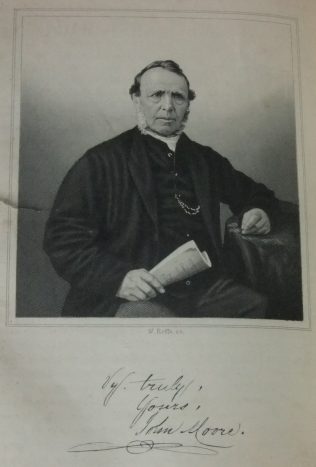
My great-great-grandfather William Moore had been baptised in 1805 in Motcombe to William and Anna, making him the older brother of this John Moore, Methodist convert.
A little more digging in the fertile swathes of the internet led me to a detailed biographical article about Rev John Moore. Apparently he recorded the conversion event and stated it was "November 5, 1826, at half-past ten o'clock at night, while on my knees in the kitchen of my uncle James Bartley's farm-house". (From Connexional Biography written by H.G. Button, Primitive Methodist Magazine 1876, page 297-299.)
Furthermore John Moore said, "My aunt Bartley was praying when I believed; but there were my brother, uncle Bartley, Walter, and Stephen on their knees at the same time. My brother and seven more had found the Lord at the meeting at Enmore Green the same night, where we had all been."
To my knowledge, John had one sister and one brother. Consequently, I concluded that my great-great-grandfather William Moore found the Lord at a Methodist meeting in the hamlet of Enmore Green, Motcombe, during the evening of Sunday 5th November 1826 at about 20 years of age.
I was truly delighted and amazed to have found such personal and specific details about a relative from nearly 200 years ago. However, once I had absorbed the article's biographical details about John Moore, and stared a picture of him in later life (see below), I immediately started wondering about the identity of Uncle James Bartley, Aunt Bartley, Walter and Stephen. This hobby is a never-ending chain of mysteries - once new facts have been recorded then new loose ends beguile.
Image presented on "My Primitive Methodists" website page Moore, John (1807-1875)